Formation of Earth, Conditions on Early Earth, Origins of
Life
The theory put forth to explain the origins of the Universe,
our solar system, and our planet is called the Big Bang Theory, which
says that all matter in the Universe was, at one time, concentrated in a giant
mass (a black hole?) that blew apart about 10 to 20 billion years ago (bya)
and is still expanding.
It is thought that our solar system had its origins when, about 5 bya,
triggered by some unknown cause, a cloud of interstellar dust and gases
collapsed and condensed.
Some of the matter in the central mass contracted under its own gravity,
condensed, and heated until forces were so strong that thermonuclear reactions
began, and this was the origin of our star, the Sun.
Interestingly, one astronomy book I read pointed out that the size of a star
is related to the amount of fuel it has available to burn for energy and how
fast it burns up that fuel.
A star smaller than our sun would not contain enough fuel to last long enough
for evolution to have occurred here on earth.
A larger star would have burned its fuel too fast, and would have burned
itself out long ago, also not lasting long enough for life to evolve on Earth.
This book pointed out that our sun is just the right size!
About 4.6 to 4.5 bya, a disk-shaped cloud of subsidiary
smaller lumps, pieces, dust, gases, etc.
orbiting the sun subsequently coalesced and condensed to form the
planets,
satellites,
asteroids,
comets,
etc. It is thought that Earth began as a cold world, and the very first
atmosphere may have been hydrogen gas, but since that is so light weight and
very chemically reactive, most of it would have floated off into space or
reacted with other substances, thus would have been rapidly dissipated.
The first “real” atmosphere is thought to be due to subsequent volcanic
activity and other chemical reactions taking place.
It is thought that the inner four, solid planets may have started out with
similar
atmospheres
of H2O, CO2, CO, and N2.
According to current thinking, NH3 is now “off the list” because
it is so reactive, that scientists believe it would have formed H2,
which would have floated off into space, and N2 which would have
stayed
in the early atmosphere. It is thought that these chemicals made up the
atmosphere of our planet for the first 1 billion years, and initially,
provided similar atmospheres for the other three solid planets. However,
the distance of each of these
planets from the sun has influenced what subsequently took place there.
- Mercury is too close to the sun and too hot. Any water that might
have been there (and any other volatile chemicals) would, long ago,
have evaporated into space.
- Venus also is too close to the sun to have any surface water. The
climate there is classified as a “run-away greenhouse effect.” While
Venus probably has torrential rains from its heavy cloud cover,
the high heat almost immediately evaporates any surface water.
- Mars, on the other hand, is too far away from the sun, and so is
too cold. Any water and carbon dioxide present on the planet are
frozen solid in the “ice” cap (a tiny bit of CO2 thaws out
and provides a thin atmosphere over portions
of the planet during the Martian summer. Also, the planet is too small
to hold very much atmosphere, and there is not enough of a greenhouse
effect to keep the planet warm. Thus, there is essentially no
atmosphere left.
- Once again, conditions happen to be just right here on planet Earth.
We are just the right distance from the sun! On Earth, the heat and the
size are such that the water is neither all frozen nor all vaporized.
Because liquid water is present,
this has enabled formation of the lakes and oceans needed for life to
evolve.
 Over the next 3.5 billion years, the amount of CO2 in our
atmosphere
was reduced as it became incorporated into rocks (limestone is CaCO3
and forms when H2O + CO2 → H2CO3
and H2CO3 + Ca++ → CaCO3 +
2H+).
The liquid oceans formed about 3.8 bya, and life has been present for nearly
as long.
Over the next 3.5 billion years, the amount of CO2 in our
atmosphere
was reduced as it became incorporated into rocks (limestone is CaCO3
and forms when H2O + CO2 → H2CO3
and H2CO3 + Ca++ → CaCO3 +
2H+).
The liquid oceans formed about 3.8 bya, and life has been present for nearly
as long.
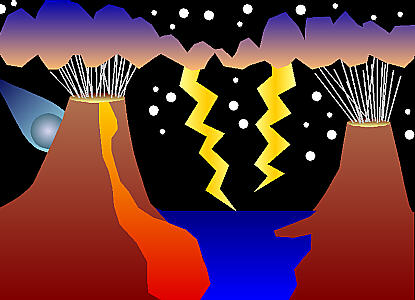
Evidence would indicate that on early
Earth, there was much
more volcanic activity, many more electrical storms, and more violent and
destructive meteor impacts which could have heated the earth, melting part
of the crust (one theory says the moon formed when a big, molten chunk of
crust was knocked/blown off from the rest of the planet) and vaporizing part
of the atmosphere.
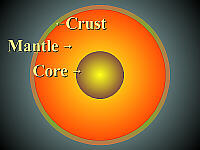 Because of this impact heating (and Earth’s internal heat) the Earth
subsequently
melted, and heavier molten materials sank to
the center, forming the core, while lighter ones floated to surface
and formed the crust. Thus Earth now has several layers:
Because of this impact heating (and Earth’s internal heat) the Earth
subsequently
melted, and heavier molten materials sank to
the center, forming the core, while lighter ones floated to surface
and formed the crust. Thus Earth now has several layers:
- A central core composed of very dense metals such as iron
and nickle
- The mantle, which actually consists of several layers of
varying composition, and is a molten, medium density, viscous
liquid
- The crust floats on the outside. Because the minerals in
the crust are cooler, they have formed strong, rocky layers
collectively referred to as the
lithosphere.
This is not a single shell, but a patchwork of plates that
ride on the mantle and move relative to each other.
Plate tectonics
is the study of the interactions among the plates of the Earth’s crust.
Deep in the oceans, are ridges where new lithosphere is formed and the sea
floor is spreading and in other locations, there are trenches where old
lithosphere is folding in. The continents float/ride on some
of the plates, leading to continental drift. The continents are not
recycled like ocean floor, but can
separate or collide with each other. Wherever two continental plates
collide, mountains are pushed up.
 It is thought that several major steps had to occur for life to form on early
Earth. Alexander Ivanovich Oparin (publ 1936), a Russian scientist, in
The Origins of Life, described hypothetical conditions which he felt
would have been necessary for life to first come into existence on early
Earth. He thought the atmosphere was
made largely of water vapor (H2O), carbon dioxide (CO2),
carbon monoxide (CO), nitrogen (N2), methane (CH4), and
ammonia (NH3).
As the surface of Earth cooled again, torrential rains of this mixture formed
the first seas, the “primordial soup.”
Lightening, ultraviolet (UV) radiation, and volcanic action all were more
intense than they are now.
It is thought that several major steps had to occur for life to form on early
Earth. Alexander Ivanovich Oparin (publ 1936), a Russian scientist, in
The Origins of Life, described hypothetical conditions which he felt
would have been necessary for life to first come into existence on early
Earth. He thought the atmosphere was
made largely of water vapor (H2O), carbon dioxide (CO2),
carbon monoxide (CO), nitrogen (N2), methane (CH4), and
ammonia (NH3).
As the surface of Earth cooled again, torrential rains of this mixture formed
the first seas, the “primordial soup.”
Lightening, ultraviolet (UV) radiation, and volcanic action all were more
intense than they are now.
- First, organic
monomers
(simple sugars, amino acids, fatty acids, and nucleotides) would have
to be synthesized
abiotically
from inorganic substances like methane, carbon dioxide, and ammonia.
This hypothesis was later tested by an experiment done by Stanley
Miller as a grad student under Harold Urey in 1953.
H2O, H2, CH4 and NH3 (at
that time, thought
to be components of the early atmosphere) were placed in a sterile,
closed system. Heat was added to mimic the heat from volcanic
activity, and electric sparks were provided to mimic lightening.
After one week, the contents of this system had turned from clear to
a murky, brown color. A chemical analysis showed a number of organic
compounds were present, including several amino acids and simple
sugars.
Other researchers have since tried similar experiments with slight
variations
in the initial mix of chemicals added, and by now, all 20 amino acids,
and a
number of sugars, lipids, and nucleotides have been obtained in this
manner.
From this experiment, scientists generalize that if this can happen
in a lab,
it could have happened in a similar way on early Earth.
- The second step would be the
formation of organic polymers and genetic material from the existing
monomers (polysaccharides from simple sugars, proteins from amino
acids, and RNA from nucleotides), possibly using hot sand or finely
divided clay as a catalyst.
- Thirdly, it is thought that
non-living aggregates of these polymers formed. These may have
exhibited some properties characteristic of living organisms,
but were NOT ALIVE, and did not have all the properties of living
organisms. In a
research laboratory, scientists have seen mixtures of proteins, lipids,
and carbohydrates form globules. If the proteins involved happen to be
enzymes, these globules can even carry on “metabolic” activity,
although they have no means to replicate
themselves. Simultaneous to this, the genetic code would have to
have arisen. Several widely-accepted theories as to how this may
have happened include the possibly involvement of damp,
zinc-containing clay as a catalyst to help the nucleotides
polymerize first into RNA, and later into DNA.
- It is thought, then, that
about 4.1 to 3.5 bya, the first
prokaryotes,
like bacteria, came into existance. It is difficult to pinpoint a
date for this because bacteria don’t have skeletons to leave behind.
The first “fossils” (remains of colonies/secretions) of prokaryotes
seem to be this age. These would have been very simple cells without
many of the organelles present in modern cells, especially modern
eukaryotes.
Once the first cells, the first living organisms, the first
prokaryotes came into existance, then the Theory of Evolution takes
over to provide an explanation for how (not why) these primitive
cells diversified into the five
kingdoms of life which we recognize today.
Initially, the energy needed for growth and development was
supplied by
glycolysis
and fermentation. There was no free oxygen in the early atmosphere, and
indeed, any organisms living back then would have probably been poisoned/killed
by this highly-reactive chemical.
Only later, as
photosynthetic
organisms released increasing amounts of this toxic waste into the atmosphere,
did the process of cellular respiration evolve as a means of making use
of this oxygen.
Copyright © 1999 by J. Stein Carter. All rights reserved.
This page has been accessed  times since 25 Mar 2001.