Human Impact and Intervention
Clearing Land
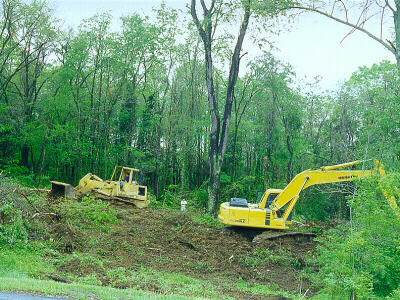
Scenes from Our Campus
 By clearing land for agriculture or logging, large formerly-forested areas of
the Middle-East and Europe have been turned into deserts. This also causes
major soil erosion which is one of our major ecological problems, worldwide.
Problems here in the U. S. caused the Dust Bowl in the 1930s. These problems
were subsequently partially overcome by people on small, family farms
planting windbreaks, rotating crops, etc. However, the large, post-WWII
corporate farms went back to monoculture and tore out the windbreaks that
were in the way of big machines, thereby bringing the erosion problems back,
even worse than before. I recall reading about an area of, I think it was,
Spain that originally had been a lush, forested area, but for much of recent
history was a hot, nearly-inhospitable, desert-like area. A local man
undertook it as his life’s work to re-plant as many trees as he could, and
to encourage others to do the same. Now, a generation or two later, the
climate of the area has changed noticably. The presence of trees changed
not only the localized microclimate, but influenced the overall climate in
the area, including temperature and humidity.
By clearing land for agriculture or logging, large formerly-forested areas of
the Middle-East and Europe have been turned into deserts. This also causes
major soil erosion which is one of our major ecological problems, worldwide.
Problems here in the U. S. caused the Dust Bowl in the 1930s. These problems
were subsequently partially overcome by people on small, family farms
planting windbreaks, rotating crops, etc. However, the large, post-WWII
corporate farms went back to monoculture and tore out the windbreaks that
were in the way of big machines, thereby bringing the erosion problems back,
even worse than before. I recall reading about an area of, I think it was,
Spain that originally had been a lush, forested area, but for much of recent
history was a hot, nearly-inhospitable, desert-like area. A local man
undertook it as his life’s work to re-plant as many trees as he could, and
to encourage others to do the same. Now, a generation or two later, the
climate of the area has changed noticably. The presence of trees changed
not only the localized microclimate, but influenced the overall climate in
the area, including temperature and humidity.
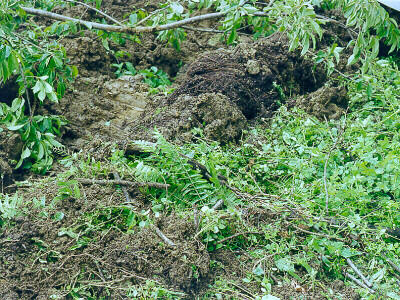
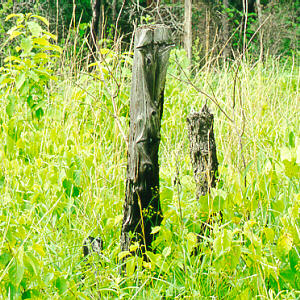
Smashed Christmas Fern
Here in the U. S., the timber industry typically clearcuts forests, then burns
the stumps to totally kill everything, then reseeds with a monoculture of
commercial, nursery-grown species. Also, dead trees (snags) are removed in
the process. These, however, provide homes/nests for a variety of wildlife.
Logging is a problem in tropical rainforest areas because desirable species
of trees are few and widely-spread, and loggers end up having to cut a lot
of other trees to make roads to haul out even one desirable tree. Often
forest destruction also allows “weedy” plants and insect pests to proliferate
in newly-cleared, agricultural areas. Some, less-drastic tree-harvesting
methods include division of a forest into strips, and cutting only the
desirable trees in only every third strip at a time.
Urbanization and Burning of Fossil Fuels
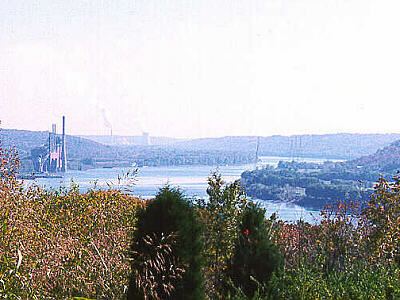 Urbanization is a major problem. Cities and their suburbs take the place of
both wild land and agricultural areas. More and more land is paved over as
roads or covered with buildings, etc. Especially in the inner city, most
species are “weedy” exotic species that are invasive and can tolerate urban
conditions. Waterways are frequently rerouted and often channelled through
concrete “ditches” or metal pipes, making it impossible for native wetland
species to survive there. Some species of human-introduced “landscape” plants
(Garlic Mustard, Amur Honeysuckle, Multiflora Rose, Euonymus, Russian
Olive) have escaped and are outcompeting local, wild species.
Urbanization is a major problem. Cities and their suburbs take the place of
both wild land and agricultural areas. More and more land is paved over as
roads or covered with buildings, etc. Especially in the inner city, most
species are “weedy” exotic species that are invasive and can tolerate urban
conditions. Waterways are frequently rerouted and often channelled through
concrete “ditches” or metal pipes, making it impossible for native wetland
species to survive there. Some species of human-introduced “landscape” plants
(Garlic Mustard, Amur Honeysuckle, Multiflora Rose, Euonymus, Russian
Olive) have escaped and are outcompeting local, wild species.
Burning of fossil fuel, and other
activities in cities change the local climate. Winter weather (snow) is
usually not as “bad” in the center of a city as in the surrounding rural
areas. City temperatures often average 6 to 8° C higher than in nearby rural
areas. Usually, things like tornados do not occur as frequently in big
cities as in rural areas, probably also due to the difference in air
temperature.
Loss of Family Farms
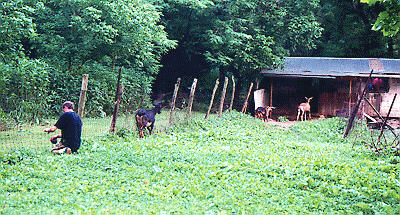 Dwindling numbers of small family farms typically grow a variety of crops
surrounded by hedgerows, windbreaks, and pockets of remaining forest and
thus, animals like rabbits, quail, and (exotic) pheasants. Today’s
agribusiness monoculture of large expanses of corn/soy has eliminated this
diversity. Hedgerows, etc. on farms can provide edge/ecotone areas and
support more wildlife.
Dwindling numbers of small family farms typically grow a variety of crops
surrounded by hedgerows, windbreaks, and pockets of remaining forest and
thus, animals like rabbits, quail, and (exotic) pheasants. Today’s
agribusiness monoculture of large expanses of corn/soy has eliminated this
diversity. Hedgerows, etc. on farms can provide edge/ecotone areas and
support more wildlife.
Draining Wetlands
Draining of wetlands for agriculture or urban sprawl causes
loss of habitat and of species/species diversity. A settlement of houses and
“cabins” around the shores of a lake is the “beginning of the end,” and the
accompanying motorboats are detrimental to aquatic wildlife. Dams are
constructed to cause major changes in the watercourse of a given
river-system.
Pollution
Pollution is a major human-induced problem. Pesticides,
herbicides, and fertilizers are washed into local water systems. Litter,
landfills, and improperly-treated sewage may potentially leach a variety of
chemicals and pathogenic bacteria into the surrounding environment.
Remember the previously-discussed example of DDT adversely affecting
production of Peregrine Falcon egg shells? Also, burning of coal, and other
fossil fuels releases sulfur and nitrogen compounds into the air. The sulfur
compounds form sulfuric acid, and the nitrogen forms nitric acid. These fall
with the precipitation as “acid rain.” Acid rain, when absorbed into the
soil, can alter the pH of the soil, therefore the solubility of various
chemical ions used as nutrients. We are increasing low-altitude
O3 (ozone) levels which shouldn’t be, and by releasing
chloroflurocarbons (CFCs) into the air, are decreasing the high-altitude
O3 that protects us all from too much sun. We are also releasing
large quantities of toxic, heavy metals (mercury, cadmium, chromium,
selenium, lead) into our soils. A brand-new problem is genetically-engineered
corn (and other crops) with BT genes in it. Bacillus turingensis is
a bacterium that invades/kills caterpillars. Its genes were incorporated
into a certain variety of corn to try to make the corn more resistant to
attack by corn borers (a type of non-descript moth). However, it has been
noted that if pollen from this corn settles on local, wild plants the BT
genes in the pollen may cause the death of any caterpillars which normally
feed on those plants. This could, then, have a negative impact on the
populations of local butterflies.
Fire Can Actually Be Good — Sometimes
 Some ecosystems depend on fire to maintain their usual flora, so humans
setting fires (accidentally?) can be both good and bad. This is bad because
a fire could destroy a habitat if it is started during the wrong time of
year, but good for the habitat if started at the proper time of year when
fire-susceptible species are killed off and growth of fire-resistant species
is encouraged. In some habitats (such as the Adams Co. prairie preserves),
humans have realized the necessity of fire and have set controlled fires on
purpose. People have recognized that in areas where fire is needed to
maintain the ecosystem, human suppression of fire can be harmful to habitats
that depend on it for regeneration, seed germination (for example, Lodgepole
Pine, Pinus contorta in Yellowstone), and killing of “invaders.”
People involved in managing the large forested areas out west now realize
that Smokey the Bear may have done too good of a job of preventing forest
fires, resulting in an abnormal build-up of dropped, dead branches, new,
brushy growth, etc., which in
turn, leads to accidentally-set fires becoming hotter and more destructive
than normal and harder to get/keep under control, resulting in much more
damage to both the forest itself and to any human structures in the vacinity.
Some ecosystems depend on fire to maintain their usual flora, so humans
setting fires (accidentally?) can be both good and bad. This is bad because
a fire could destroy a habitat if it is started during the wrong time of
year, but good for the habitat if started at the proper time of year when
fire-susceptible species are killed off and growth of fire-resistant species
is encouraged. In some habitats (such as the Adams Co. prairie preserves),
humans have realized the necessity of fire and have set controlled fires on
purpose. People have recognized that in areas where fire is needed to
maintain the ecosystem, human suppression of fire can be harmful to habitats
that depend on it for regeneration, seed germination (for example, Lodgepole
Pine, Pinus contorta in Yellowstone), and killing of “invaders.”
People involved in managing the large forested areas out west now realize
that Smokey the Bear may have done too good of a job of preventing forest
fires, resulting in an abnormal build-up of dropped, dead branches, new,
brushy growth, etc., which in
turn, leads to accidentally-set fires becoming hotter and more destructive
than normal and harder to get/keep under control, resulting in much more
damage to both the forest itself and to any human structures in the vacinity.
FYI, I had to look this up: the correct spelling for the
adjective to describe a location full of smoke is “smoky,” but the
bear’s name is “Smokey.”
If you’ve never read the story about the “real” Smokey Bear, see
Smokey’s Web site.
Also see Wikipedia info on Smokey.
Smokey has his own song (YouTube)
or song (not YouTube).
Working with Nature Is a Win-Win Situation
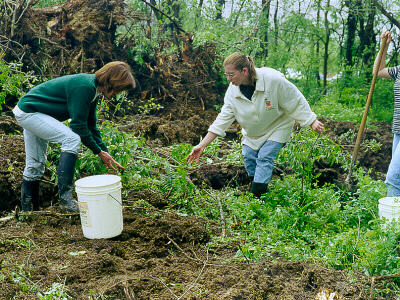
Students Rescuing Christmas Fern
A number of years ago, in Papua, New Guinea, an attempt to introduce Western
farming methods failed miserably because it was so foreign to the way the
people there did things. However, this area is home to several species of
large, showy butterflies called birdwing butterflies. These are greatly-prized
by insect collectors, and were overcollected to the point of being endangered.
Some entomologists went to that country and studied the birdwing butterflies,
discovering the specific plants eaten by the caterpillars. Based on that
information, a very successful butterfly farming “industry” was started.
On their small, family “farms,” local people plant gardens that are a mixture
of wild plants with flowers to attract adult butterflies and wild plants that
are used as caterpillar food. Wild butterflies find these gardens and lay
eggs on the host plants. The people monitor the growth of any resulting
caterpillars, and when these turn into chrysalises, they are carefully
transferred to a protected, screened-in area (maybe a porch of the people’s
homes) until the butterflies emerge. When the butterflies emerge, a very
small percentage are “harvested” for sale to insect collectors, and the rest
are released back into the wild. This “butterfly farming” has had several
positive results. The people in that country are able to use farming
methods that philosophically and physically “work” in that situation and
that don’t destroy the local ecosystems, the number of birdwing butterflies
available for sale on the international market has increased, providing a
significant source of income for that country and its citizens, and perhaps
most importantly, the numbers of these once-endangered butterflies have
increased significantly.
Setting Aside State and National Parks is Good
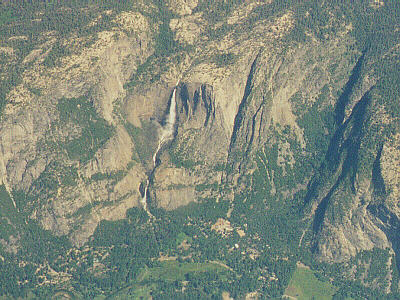
Yosemite Falls, Yosemite National Park
Even for someone who has never been there, Yosemite Falls is easily
recognizable from the window of a big airliner, high overhead!
Copyright © 1999 by J. Stein Carter. All rights reserved.
This page has been accessed  times since 25 Jun 2001.