Interspecific Relationships
and Niche
Background
Interspecific interactions
are interactions among organisms of different species. Typically, these
interactions are classified based on whether they are beneficial to one or
both of the species involved or whether they are detrimental to one of the
species involved. An organism’s
niche
is its functional role within the community, including its activities and
relationships, its “address,” its “job” or function within the community,
and how it relates to other organisms. The niche of each species is a little
different to avoid competition. Different species, even closely-related ones,
will have different food preferences, seasonality, daily feeding rhythms, and
location within the habitat. For some species of katydids within the same
genus, the difference may be as subtle as a preference for perching on the
top vs the middle of a stem on a grass plant.
Types of Relationships
- Symbiosis
- Any relationship that involves two (or more) species living together and interacting. This is a general term which includes predation, parasitism, commensalism, mutualism, etc., but often is used to mean mutualism.
- Predation
 When a larger animal eats other, smaller animals. Lions may eat
antelope, and wolves may eat deer. Spiders, like this orbweaver,
capture and eat insects such as the cricket she’s eating.
When a larger animal eats other, smaller animals. Lions may eat
antelope, and wolves may eat deer. Spiders, like this orbweaver,
capture and eat insects such as the cricket she’s eating.
- Commensalism
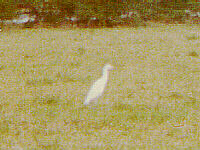 A relationship between two species that is beneficial to one but of
neutral benefit to the other. Cattle egrets follow cattle to feed on
the insects stirred up by the grazing cattle.
A relationship between two species that is beneficial to one but of
neutral benefit to the other. Cattle egrets follow cattle to feed on
the insects stirred up by the grazing cattle.
- Mutualism
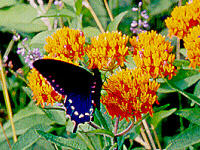 A relationship between two species where both benefit. The yucca moth
both pollinates and feeds on the yucca plant; acacia ants live in the
thorns of, defend, and are fed by the acacia tree in which they live;
and trees can’t get along without mycorrhizae living in/on their roots
and absorbing food for them. Many plants and their pollinators have
evolved mutualistic relationships. Butterfly-weed provides food for
and is pollinated by butterflies like pipevine swallowtails.
A relationship between two species where both benefit. The yucca moth
both pollinates and feeds on the yucca plant; acacia ants live in the
thorns of, defend, and are fed by the acacia tree in which they live;
and trees can’t get along without mycorrhizae living in/on their roots
and absorbing food for them. Many plants and their pollinators have
evolved mutualistic relationships. Butterfly-weed provides food for
and is pollinated by butterflies like pipevine swallowtails.
- Parasitism
 When a smaller organism feeds on a larger, weakening or killing it.
This is a relationship where one organism benefits and the other is
harmed. Often the host is not killed outright. Because a parasite
lives in/on the body of its host and needs the host to remain alive,
it is usually advantageous for the parasite to not kill its
host. Humans and domestic animals are occasionally infected with or
bothered by tapeworms, roundworms, mosquitoes and/or leeches.
When a smaller organism feeds on a larger, weakening or killing it.
This is a relationship where one organism benefits and the other is
harmed. Often the host is not killed outright. Because a parasite
lives in/on the body of its host and needs the host to remain alive,
it is usually advantageous for the parasite to not kill its
host. Humans and domestic animals are occasionally infected with or
bothered by tapeworms, roundworms, mosquitoes and/or leeches.
- Parasitoid
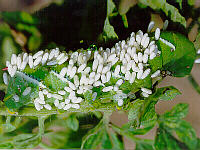 A parasite that eventually causes the death of its host. By the time
the parasitoid undergoes metamorphosis, all of the host’s innards have
been eaten. Often, insect larvae that are parasitoids of other insects
eat the host’s tissues, timing things such that just as they’re ready
to pupate, they have eaten up the whole insides of their host, and it
dies. Braconid wasps do this to tomato hornworms, and this hornworm,
covered with cocoons of pupating braconids, probably has almost no
body parts left inside. If you see a caterpillar like this on your
tomato plants, leave it alone. The wasps will eventually hatch, mate,
and lay eggs in any other tomato hornworms they can find – a good
means of biological control.
A parasite that eventually causes the death of its host. By the time
the parasitoid undergoes metamorphosis, all of the host’s innards have
been eaten. Often, insect larvae that are parasitoids of other insects
eat the host’s tissues, timing things such that just as they’re ready
to pupate, they have eaten up the whole insides of their host, and it
dies. Braconid wasps do this to tomato hornworms, and this hornworm,
covered with cocoons of pupating braconids, probably has almost no
body parts left inside. If you see a caterpillar like this on your
tomato plants, leave it alone. The wasps will eventually hatch, mate,
and lay eggs in any other tomato hornworms they can find – a good
means of biological control.
Copyright © 1999 by J. Stein Carter. All rights reserved.
This page has been accessed  times since 25 Jun 2001.